
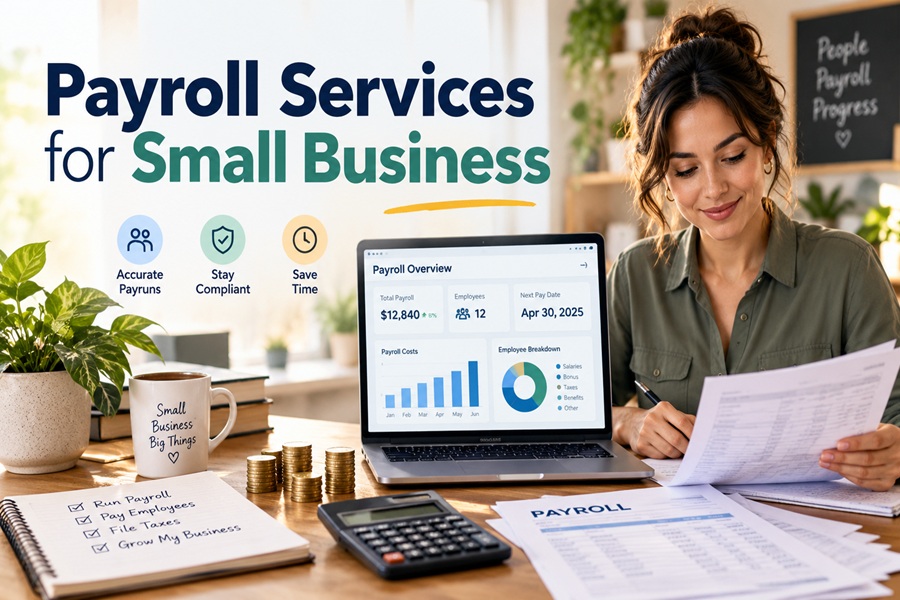
Ask a small business owner which job they would give away first and payroll usually wins. It repeats every week or two, it punishes small mistakes, and the penalties tend to arrive months after the error was made.
That delay is exactly why picking a payroll service deserves more thought than choosing the cheapest plan on a pricing page. Outsourcing moves the work. It does not always move the liability. Knowing where that line sits is what separates a provider that protects you from one that simply hides problems until an IRS notice lands in the mailbox.
What payroll really involves once you hire
Running payroll is not one task. It is a bundle of small obligations, each with its own calendar:
- Calculating gross pay from salaries, hourly rates, overtime, tips and commissions
- Withholding federal income tax based on each employee’s Form W-4
- Withholding Social Security and Medicare, then matching both as the employer
- Paying federal unemployment tax (FUTA) and your state unemployment insurance
- Handling state and local income tax where it applies
- Processing garnishments, retirement contributions and benefit deductions
- Depositing taxes on a monthly or semiweekly schedule set by the IRS
- Filing Form 941 every quarter and Form 940 every year
- Sending W-2s to employees and the Social Security Administration by January 31
- Reporting new hires to your state
Miss one deposit date and the penalty clock starts.
Five ways small businesses get it done
Payroll services sit on a spectrum. Some do the math and leave the filing to you. Others take on nearly everything.
| Approach | Who calculates | Who files and deposits | Who carries federal tax liability |
|---|---|---|---|
| Doing it yourself | You | You | You |
| Self service software | Software | You | You |
| Full service online payroll | Provider | Provider, acting as your agent | Still you |
| Accountant or bookkeeper | Accountant | Accountant | Still you |
| Certified PEO | PEO | PEO | Shifts to the CPEO for wages it pays |
Most businesses with fewer than 50 people land in the full service row. Patriot’s Basic plan is a good example of the self service row, where the software calculates and you handle deposits and forms. Its Full Service plan, like Gusto, OnPay and ADP RUN, files and pays on your behalf.
What a full service provider takes off your desk
A full service provider calculates every paycheck, pays employees by direct deposit, withdraws the tax money from your account, deposits it with the IRS and state agencies, and files the quarterly and annual returns. Most also produce W-2s and 1099s, register you with some state agencies, and keep pay records you can pull when an auditor or lender asks.
Time tracking, onboarding, benefits and workers’ compensation are common add ons, and they are often where the monthly bill quietly grows.
The liability that stays in your name
Here is the part many owners never hear during a sales call. When a payroll company files for you, it usually does so as your reporting agent under an authorization called Form 8655. The IRS still sees you as the employer.
The income tax you withhold and the employee half of Social Security and Medicare are called trust fund taxes. You are holding that money for the government. If it never reaches the Treasury, the IRS can assess the Trust Fund Recovery Penalty, which equals 100 percent of the unpaid amount, against the people responsible for paying it. That can include owners personally.
It does not matter whether the shortfall was your fault or the provider’s. The one structural exception is a Certified Professional Employer Organization. Under the IRS CPEO program, a certified PEO becomes responsible for federal employment taxes on the wages it pays to your workers. An ordinary PEO without that certification does not give you the same protection, so ask for proof of certification rather than assuming.
A simple habit closes most of the risk. Once a quarter, log in to your IRS business tax account or EFTPS and confirm the deposits match your payroll reports. It takes ten minutes and it is the only way to know the money actually arrived.
Shifts in the payroll world worth knowing
The payroll market has moved fast lately, and a few changes affect small employers directly.
Intuit renamed QuickBooks Online Payroll as QuickBooks Workforce. New subscriptions saw higher per employee fees starting July 1, and QuickBooks now pays and files payroll taxes automatically, pulling the tax money when you run payroll rather than on the due date. There is no manual option anymore, which changes cash flow planning for tight months.
Gusto raised its entry Simple plan from $40 to $49 a month in March and added Mosey, a compliance tool focused on state registrations, in April.
Paychex has folded Paycor into its business and now sells through Paychex Flex, SurePayroll and Paycor. In May it launched an AI platform called WISE, which it says now powers around 600 AI features across those products.
The federal government has also pushed payments onto electronic rails. Employment tax deposits must go through EFTPS, Direct Pay for businesses or a business tax account, which means a provider that still talks about mailing checks is behind the times.
Finally, the new law on tips and overtime added fresh boxes to the W-2. Employers now report qualified tips, qualified overtime and tipped occupation codes. A provider that tracks this all year saves you a messy scramble in January.
Questions to put to any provider before you sign
- Do you file and deposit federal, state and local taxes, or only calculate them?
- If you make a tax error, who pays the penalty and interest?
- How many business days before payday do you need payroll submitted?
- Are W-2s, 1099s and year end filings included or billed separately?
- What happens to my data and filings if I leave mid year?
- Is support handled by a named rep, a pooled team or a chatbot?
The answer to the penalty question is especially telling. Most reputable providers will cover penalties caused by their own mistakes. Few will cover penalties caused by data you entered late or wrong.
Matching the service to the stage you are in
A business with one or two employees and an owner who enjoys spreadsheets can get by with self service software and a calendar of deposit dates. Once you pass a handful of people, hire in a second state, or start paying tips and overtime, full service payroll usually pays for itself in avoided mistakes alone. Teams that want better health insurance pricing and fewer HR headaches often grow into a PEO, ideally a certified one.
Whichever level you choose, treat the provider as a partner you verify rather than a black box you trust. The paychecks will look the same either way. The difference shows up when something goes wrong and you need to know whose name is on the problem.