
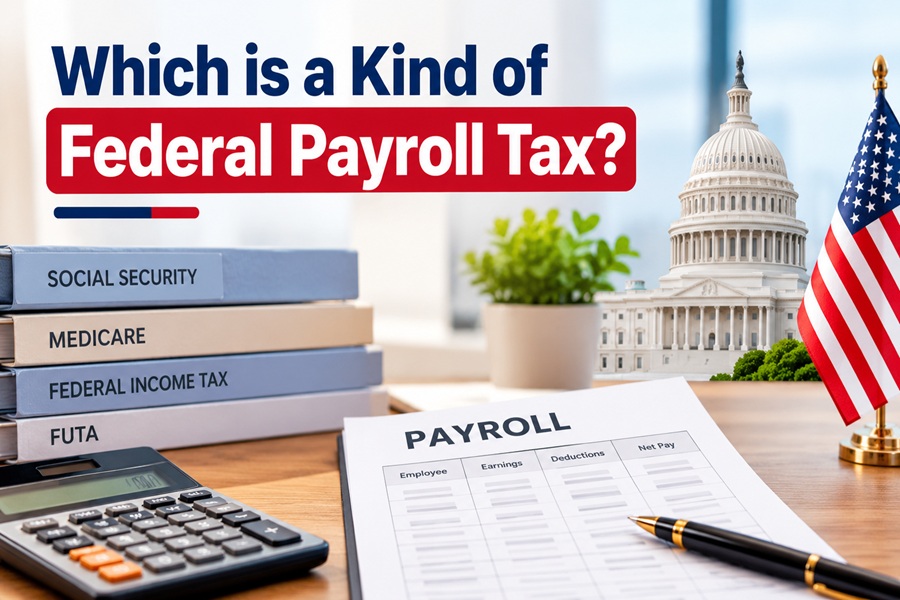
If you came here from a quiz or a textbook question, the short answer is this: Social Security tax is a kind of federal payroll tax. So is Medicare tax, and together the two are known as FICA, named after the Federal Insurance Contributions Act. Federal unemployment tax, or FUTA, is a federal payroll tax as well.
Sales tax, property tax and state income tax are not. When a multiple choice question lists one of those beside Social Security or Medicare, the federal payroll tax is the Social Security or Medicare option.
That is the test answer. The real world version has more moving parts, and anyone running a business needs the full picture.
Two ideas that make payroll tax easier to understand
Federal payroll taxes are taxes tied to wages. They are calculated on what an employee earns, and they fund specific programs rather than general government spending. Social Security tax funds retirement, disability and survivor benefits. Medicare tax funds hospital insurance. FUTA funds the federal side of the unemployment insurance system.
The second idea is that each tax has its own payer. Some are split between worker and employer, some fall only on the employee, and one falls only on the employer.
Federal income tax withholding sits slightly apart. It is taken out of paychecks and reported on the same forms, which is why many people group it with payroll taxes. Technically it is an income tax the employer collects in advance, not a payroll tax funding a social program.
Who pays what
| Tax | Employee pays | Employer pays | Wage limit |
|---|---|---|---|
| Social Security | 6.2% | 6.2% | First $184,500 of wages this year |
| Medicare | 1.45% | 1.45% | No limit |
| Additional Medicare | 0.9% | Nothing | Wages above $200,000 |
| FUTA | Nothing | 6.0%, usually cut to 0.6% by state credits | First $7,000 of wages |
| Federal income tax withholding | Based on Form W-4 | Nothing | No limit |
The Social Security wage base rose from $176,100 last year to $184,500, an increase of $8,400. That puts the most an employee can pay in Social Security tax for the year at $11,439, with the employer matching the same amount. The trustees have already projected a base of around $190,200 for next year.
A worked example with one paycheck
Picture an employee earning $52,000 a year, paid every two weeks. Each gross paycheck is $2,000.
- Social Security withheld: $124.00
- Medicare withheld: $29.00
- Employee share of FICA in total: $153.00
The employer then matches $124.00 for Social Security and $29.00 for Medicare, another $153.00 that never appears on the employee’s stub.
FUTA works differently. The employer pays 0.6% on the first $7,000 of that employee’s wages, which comes to $42 for the whole year. Once those first $7,000 are paid out, early in the year for most full time staff, FUTA stops for that person.
Over a full year, this one employee generates $3,978 in FICA from their own pay and another $3,978 from the employer, plus $42 in FUTA.
Things people mistake for federal payroll taxes
Several taxes look similar on a pay stub but belong in a different box.
State unemployment insurance, often called SUTA or SUI, is a state tax. Rates and wage bases vary enormously from one state to the next, and they depend on how many former employees have claimed benefits against your account.
State and local income taxes are withheld through payroll but are not federal.
Self employment tax is the cousin of FICA. Freelancers and sole proprietors pay both halves themselves, 15.3% on earnings up to the wage base, through their annual return rather than through payroll.
Sales tax has nothing to do with wages at all.
How federal payroll taxes reach the Treasury
Collecting the money is only half the job. Employers deposit federal income tax withholding and both halves of FICA on a schedule the IRS assigns. Smaller employers usually deposit monthly. Larger ones deposit semiweekly. A business that racks up $100,000 or more in liability on a single day must deposit by the next business day.
Those deposits must be made electronically. Treasury and the IRS have been phasing out paper checks, and employment tax deposits go through EFTPS, Direct Pay for businesses or the IRS business tax account.
Then come the returns. Form 941 reports FICA and income tax withholding every quarter. Very small employers with $1,000 or less in annual liability may be allowed to file Form 944 once a year instead. Form 940 reports FUTA annually.
When FUTA costs more than $42
That standard 0.6% assumes your state has repaid any federal loans it used to cover unemployment benefits. When a state has not, its employers lose part of their FUTA credit.
For last year’s wages, California employers faced a 1.2% credit reduction, adding up to $84 per employee, and the U.S. Virgin Islands faced 4.5%, or up to $315 per employee. The extra amount was due with Form 940 in early February. The Labor Department’s early list for the current year shows both places again with larger potential reductions, and the final list is set in November.
What the new tips and overtime rules did not change
The tax law signed in July of last year created deductions for qualified tips and qualified overtime, and the W-2 now carries new codes for both amounts. Many workers assumed this meant no tax at all on that pay.
It does not apply to payroll taxes. The deductions reduce federal income tax on an employee’s return. Social Security and Medicare are still withheld on tips and overtime, and employers still match them.
Why the employee share is treated so seriously
The Social Security and Medicare withheld from paychecks, along with income tax withholding, are known as trust fund taxes. The business is holding that money on behalf of employees and the government.
If an employer withholds it and fails to send it in, the IRS can charge the Trust Fund Recovery Penalty, equal to 100% of the unpaid amount, to the individuals responsible for paying it. That personal exposure is why payroll taxes sit near the top of every accountant’s list of things a small business owner can never afford to get wrong.
So the answer to “which is a kind of federal payroll tax” is Social Security, Medicare or FUTA. The answer to what it means for your business is a set of rates, caps and deadlines that reward anyone who takes them seriously from the very first hire.