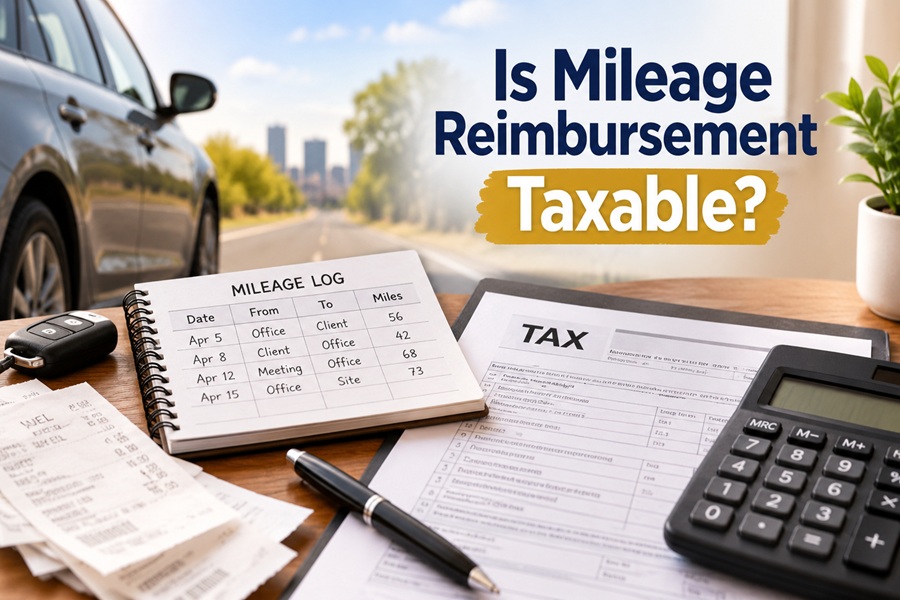
Most of the time, no. Mileage reimbursement is not taxable when your employer pays it through what the IRS calls an accountable plan and the payment stays at or below the IRS standard mileage rate. In that case the money never shows up on your W2, and you owe nothing on it.
That short answer hides a lot of fine print, though. The same check for the same miles can be completely tax free at one company and fully taxable at another. The difference comes down to how the employer runs its plan, how much it pays per mile and what kind of driving you did.
The Accountable Plan Is What Keeps It Tax Free
The IRS treats a reimbursement as a repayment of your costs, not as pay, only when three conditions are met.
- There is a business connection. The miles must be driven for work, such as visiting clients, traveling between job sites or running business errands.
- You substantiate the expense. You report the date, the miles, the destination and the business purpose within a reasonable time. The IRS treats 60 days after the trip as a safe benchmark.
- You return any excess. If you received an advance that was bigger than your actual expenses, you give back the difference, generally within 120 days.
When all three boxes are checked, the payment is excluded from your income. Your employer does not withhold income tax on it, and neither of you pays Social Security or Medicare tax on it.
If even one condition fails, the arrangement becomes a nonaccountable plan. Every dollar paid under it is treated as wages. It goes on your W2, and taxes come out just like your regular paycheck.
The 2026 Rate Changed Halfway Through the Year
The IRS rate matters because it is the ceiling for tax free reimbursement. In late December 2025 the IRS set the business rate at 72.5 cents per mile for 2026, up 2.5 cents from the year before.
Then something unusual happened. Citing higher fuel prices, the IRS issued a midyear increase. For business driving on or after July 1, 2026, the rate became 76 cents per mile. The medical and qualifying military moving rate rose from 20.5 to 23.5 cents, while the charitable rate stayed at 14 cents because Congress sets that number by law. The last time the IRS made a midyear change like this was in 2022, after another spike in fuel costs.
The practical effect is that 2026 is a split year. Miles driven from January through June use 72.5 cents. Miles driven from July through December use 76 cents. An employer paying 76 cents for a trip taken in March would be paying above the limit for that trip.
When Part or All of the Money Becomes Taxable
Here is how common situations play out.
| Situation | Tax treatment |
|---|---|
| Reimbursed at or below the IRS rate with a mileage log | Not taxable |
| Reimbursed above the IRS rate | The amount above the rate is taxable wages |
| Flat monthly car allowance with no mileage reporting | Fully taxable as wages |
| Reimbursement for your normal commute | Taxable, because commuting is personal |
| Fixed and variable rate (FAVR) plan that follows IRS rules | Not taxable |
| Payment with no proof of miles driven | Taxable under a nonaccountable plan |
The car allowance row catches a lot of people off guard. A $500 monthly allowance feels like a reimbursement, but if nobody tracks the actual business miles, the IRS sees it as extra salary. Employers who want to offer a flat amount without the tax hit often use a FAVR program instead, which combines a fixed monthly payment for costs like insurance and depreciation with a variable per mile amount for fuel and maintenance.
Commuting is the other trap. Driving from home to your regular workplace is personal travel, no matter how long the drive is. If your employer reimburses it, that money is taxable. Driving from the office to a client site, or between two work locations during the day, is business travel.
Contractors and Gig Drivers Play by Different Rules
Independent contractors are not employees, so the accountable plan framework works differently for them. If a client simply pays you extra for mileage and you do not account to that client for the expense, the payment is generally part of your income and may appear on your 1099.
The upside is that self employed people can deduct business miles on Schedule C, using either the standard rate or actual vehicle expenses. The math often evens out. You report the reimbursement as income and take the mileage deduction against it.
Rideshare and delivery drivers fall into this group. Their platform earnings are income, and their business miles, including the miles driven while waiting for or heading to a pickup in many cases, can be deducted if they keep good records.
What If Your Employer Pays Nothing at All?
This is where many employees get frustrated. Under federal law, W2 employees can no longer deduct unreimbursed work expenses on their own returns. That deduction was suspended starting in 2018, and Congress made the change permanent in 2025. If your employer does not reimburse your miles, there is generally no federal tax break waiting for you.
State law can help. California requires employers to reimburse necessary business expenses, including mileage, under Labor Code section 2802. Illinois has a similar expense reimbursement law. A few other states have their own rules, so it is worth checking your state labor department if your employer offers nothing.
Records Make or Break the Exclusion
A reimbursement is only as safe as the log behind it. Each business trip should note:
- The date of the trip
- The starting point and destination
- The business purpose, such as “client meeting with Harper Dental”
- The total miles driven
Odometer photos, calendar entries and mileage tracking apps all work. What does not work is a round number written down months later. In a split rate year like 2026, the date column matters even more, because it decides whether a mile is worth 72.5 or 76 cents.
A Quick Way to Check Your Own Situation
Look at your pay stub and your W2. If mileage money appears inside your gross wages, your employer is treating it as taxable, and you can ask HR whether the plan meets accountable plan rules. If it is paid separately through expense reports and does not show up as wages, it is almost certainly tax free.
Mileage reimbursement is designed to make you whole for using your own car, not to give you a raise. As long as the payments match real business miles, stay within the IRS rate for the date driven and are backed by a log, the tax bill on that money stays at zero.
Leave a Reply